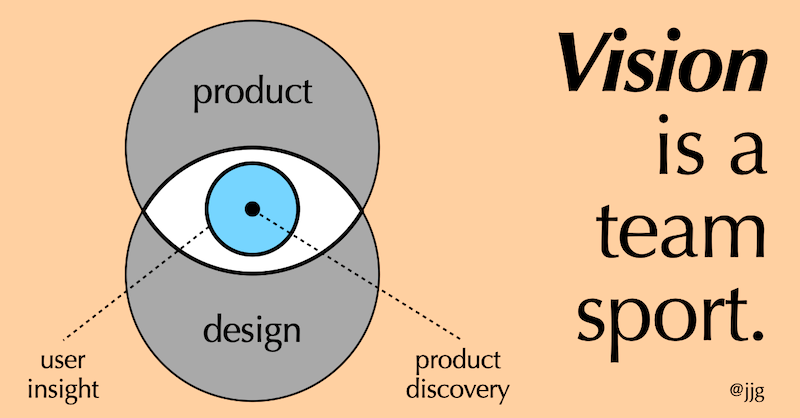
So let’s talk about Brian Chesky, and what he had to say about product and design at Config last month. Chesky made a stir in both communities when he declared that Airbnb “got rid of the classic product management function” in favor of an Apple-style approach putting design in the driver’s seat.
The reaction in the room also made it clear that Chesky had touched a raw nerve among those designers who have felt pushed around by product for too long. Chesky sensed it too, almost immediately walking back his statement to clarify they’d really just redefined those jobs, not eliminated them.
But regardless of what product management now looks like at Airbnb, what I find more interesting is the reason for Chesky’s moves: the problem he thinks this will solve.
He describes an organization in a state of paralysis, unable to move in a unified fashion towards a holistic strategy. Too many interdependencies among too large a community of product managers with distinct domains of control made it impossible for anyone to know what their real priorities ought to be.
To address this, Chesky aligned product discovery, prioritization, and roadmapping activities previously held by product managers with design processes instead, empowering his design leaders to facilitate them. Chesky himself is “orchestra conductor”, as he puts it, validating all product direction against his own holistic understanding of the product and the strategy.
In short, the company couldn’t move because they couldn’t see where they were going. As a designer himself, Chesky naturally saw this task of vision as part of design’s value proposition. But Airbnb wasn’t realizing that value because product owned everything to do with vision—even if all the visions together added up to a blurry mess. So Chesky’s reframing of product was less about elevating design than it was about rebalancing this mutually-dependent relationship.
It’s a familiar situation among many of my coaching clients. At the center of this tug of war is user insight, the qualitative and quantitative analysis needed to drive product discovery. You will find people on both design and product sides declaring that their side needs a say over these processes in order to be successful. The truth is, neither side is wrong. But gatekeeping and disempowering your most critical partners isn’t a winning strategy either.
More broadly: Any frame for our work together that sets product and design up as adversaries is ultimately doomed to fail. The hoarding of control over user insight and product discovery is the problem, not whether it’s design or product doing it.
We must move beyond zero-sum thinking where product has to lose in order for design to win, and vice versa. But if you’re not a CEO like Brian Chesky, you can’t mandate that shift—you have to catalyze it.
 Jesse James Garrett